


The Vanguard Total Stock Market ETF (VTI) tracks the CRSP US Total Market Index, giving investors exposure to roughly 3,600 stocks in a single fund: large caps, mid caps, small caps and even micro caps.
However, for long-term Indian investors, VTI carries a critical structural risk: the US Estate Tax. If you hold US-domiciled assets like VTI and your holdings exceed $60,000, your estate faces US estate tax at progressive rates reaching 40% upon your death. On a $500,000 holding that works out to roughly 29% of the portfolio.
This blog gives you all the information you need about the top UCITS alternatives. While no UCITS ETF perfectly replicates the total market portfolio of VTI, the alternatives listed below track the S&P 500, which has a high historical correlation with VTI, providing very similar returns without the estate tax risk.
Table of contents
- Why Indians are looking for UCITS alternatives to VTI
- Popular UCITS alternatives for VTI
- Invest in UCITS ETFs with Paasa
Why Indians are looking for UCITS alternatives to VTI
Indian investors are shifting to UCITS alternatives because they solve the tax risks and inefficiencies of US ETFs like VTI while providing very close to the same exposure.
- Estate Tax Protection: UCITS funds are typically domiciled in Ireland. They are not considered "US-situs" assets, meaning they are 100% exempt from US Estate Tax.
- Tax Deferral (Accumulation): Unlike VTI, which forces taxable cash dividends on you, many UCITS funds offer "Accumulating" classes that reinvest dividends automatically. This defers your Indian tax liability until you sell the fund, and converts what would have been slab-rate dividend income into capital gains.
To learn more about UCITS ETFs and why Indian investors are choosing them, read our guide on UCITS ETFs.
Popular UCITS alternatives for VTI
Here are the top three UCITS funds that serve as the best proxies for the US Total Market.
1. Vanguard S&P 500 UCITS ETF
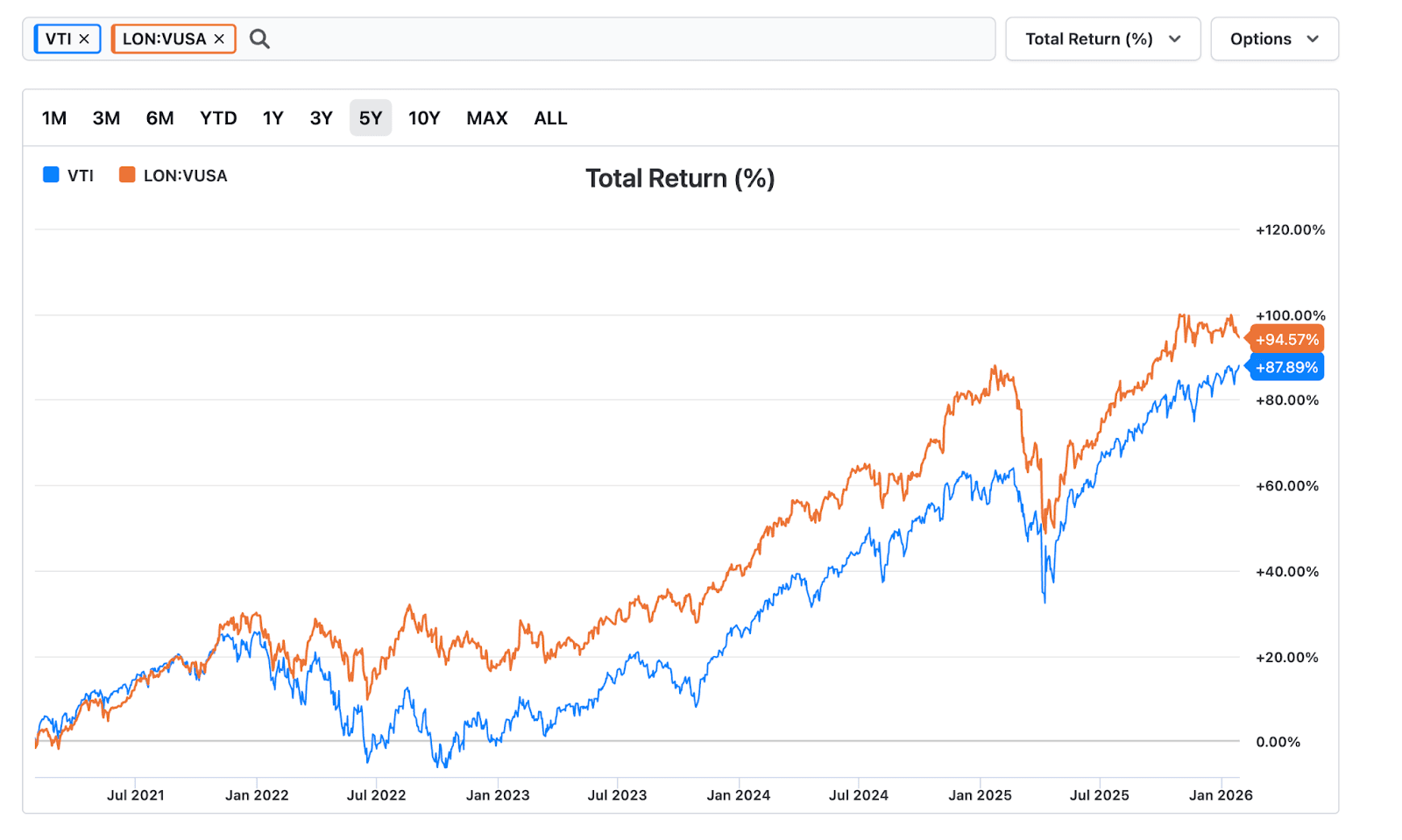
Vanguard does not offer a total US market UCITS ETF in Europe, so this is its closest UCITS option. It holds 500 stocks instead of VTI's full market coverage, though the historical performance difference has been small.
Because the US market is weighted by market cap, the top 500 companies drive the vast majority of VTI's returns. This fund offers the classic Vanguard low-cost structure with the safety of an Ireland domicile.
- Ticker: VUAA (LSE, USD), accumulating; VUSA (LSE, GBP) is the distributing line
- Total Expense Ratio (TER): 0.07%
- Structure: Accumulating (VUAA) or Distributing (VUSA)
- Top Holdings: NVIDIA, Apple, Microsoft, Amazon, Alphabet.
2. iShares Core S&P 500 UCITS ETF
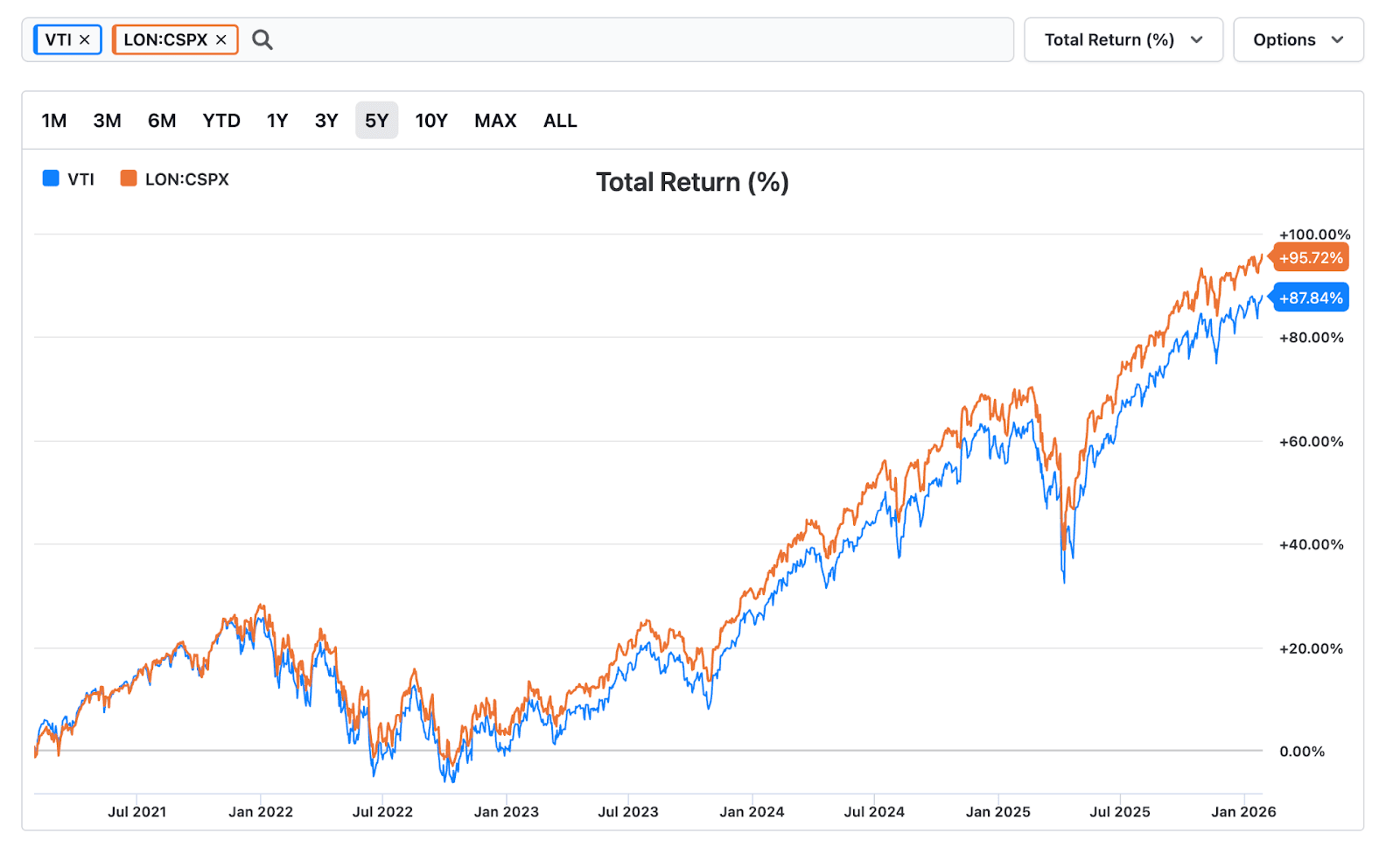
CSPX is one of the largest US equity UCITS ETFs available and uses an Accumulating (Acc) structure.
Instead of paying out dividends (which would be taxed at your income slab in India), the fund reinvests them in its holdings, which creates a tax-deferred compounding effect over a 10-20 year horizon.
- Ticker: CSPX (LSE, USD)
- Total Expense Ratio (TER): 0.07%
- Structure: Accumulating (Reinvests dividends)
- Top Holdings: NVIDIA, Apple, Microsoft, Amazon, Alphabet.
3. Invesco S&P 500 UCITS ETF
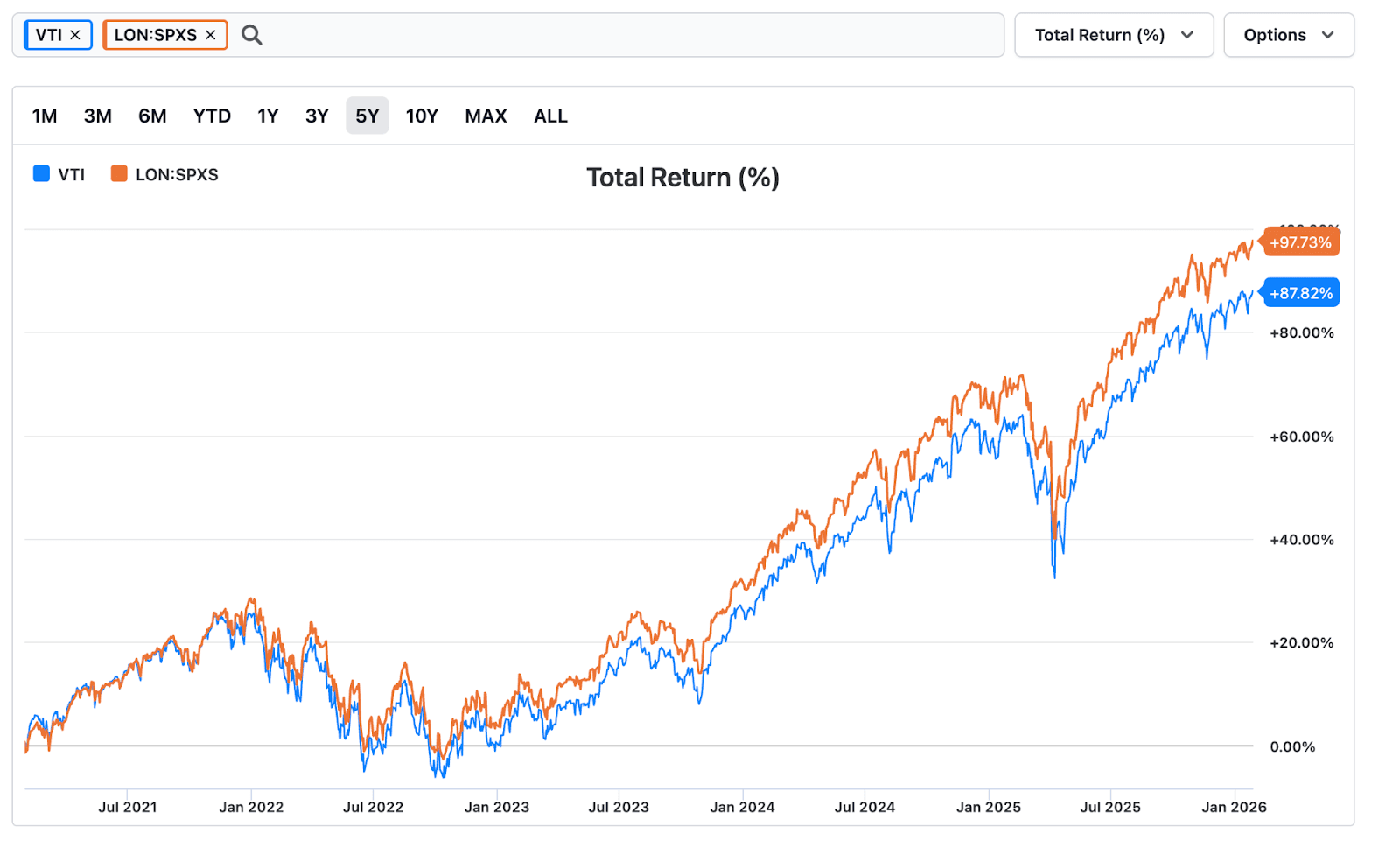
This fund uses a swap-based (synthetic) structure. It tracks the same index, and the swap can avoid the US withholding tax on dividends that physical funds like CSPX pay, which can give it a slight performance edge.
On cost, its headline ongoing charge is 0.05%, but that is not the full figure. Invesco's factsheet lists a separate swap fee of 0.07% a year, which is built into the swap's return rather than charged separately, so the all-in cost is closer to 0.12%.
Judge it on tracking difference rather than the headline charge: on Invesco's figures to 30 September 2026, the fund returned 15.60% over one year and 311.46% over ten, against 15.34% and 296.24% for the index, a one-year tracking difference of about +0.26 percentage points (a negative figure would mean the fund lagged).
The trade-off is counterparty risk. As the same factsheet sets out, if a counterparty failed to pay the index performance due under the swap contract, the ETF would instead rely on its own portfolio of equities, which could return less than the index.
- Ticker: SPXS (LSE, USD)
- Cost: 0.05% ongoing charge plus 0.07% swap fee
- Structure: Accumulating (Reinvests dividends)
- Replication: Synthetic, via swap with a substitute equity basket

More UCITS alternatives: UCITS alternatives to VOO and UCITS alternatives to AVUV.
Related: What are UCITS ETFs? and Should you switch from US ETFs to UCITS?
Invest in UCITS ETFs with Paasa
Paasa is a global investing platform designed for Indian residents and NRIs. We provide direct access to 11 markets: the US, Canada, the UK, Germany, France, Switzerland, the Netherlands, South Korea, Japan, Hong Kong and Singapore.
This means you are not restricted to just US ETFs like VTI; you can also buy tax-efficient UCITS equivalents using Paasa.
The compliance advantage
Paasa makes global investing easy and also removes the compliance friction with a specialized layer built for Indian residents and NRIs:
- Schedule FA reporting: Exact reports you need for your Indian tax returns, eliminating the need for manual calculations.
- FEMA & LRS guidance: Guidance on FEMA regulations and LRS limits to ensure compliance.
Paasa also provides access to managed strategies, along with remittance and FEMA support.

