


In the automotive and chemical sectors, Palladium has no scalable substitute. This uniqueness creates a "demand moat" that protects its value even during economic downturns.
This blog covers everything about how Indian investors can access global Palladium ETFs to diversify beyond the standard precious metals.
Table of contents
Why are investors looking at palladium exposure?
Palladium is effectively a bet on two things: cleaner cars today and cleaner energy tomorrow.
Investors are adding Palladium to their portfolios because of three structural drivers: the rise of Hybrids, the Hydrogen economy, and extreme supply concentration.
1. The "Hybrid" Bridge
Palladium’s primary use is in catalytic converters for gasoline engines .
- The Hybrid Factor: While pure EVs don't use palladium, Hybrid vehicles use more palladium than traditional cars because their engines stop and start frequently, requiring more potent catalysts to control emissions when cold.
- As the world realizes the transition to full EV will take decades, Hybrid sales are booming. This keeps palladium demand robust for the foreseeable future.
2. Hydrogen Economy
Palladium has a unique chemical property: it is an atomic "sponge" for hydrogen.
- Purification: Palladium membranes are the most effective way to filter hydrogen to the ultra-high purity (99.999%) required for fuel cells.
- Storage: Research is accelerating into using palladium to store hydrogen safely, positioning the metal as a critical component of the future green energy grid.
3. Russian Supply Shock
Palladium has one of the most concentrated supply chains on earth.
- Russia and South Africa control nearly 80% of the world's global supply.
- The Risk: With geopolitical tensions high, any disruption to Russian exports (like sanctions on Norilsk Nickel) creates an immediate supply shock that cannot be replaced by other nations, creating a "floor" under the price.
How can Indian investors buy palladium?
Indian investors essentially have two paths for adding palladium to their portfolio:
- Domestic Market: Buying commodity futures on the MCX.
- Global Markets: Buying specialized Palladium ETFs and ETCs on international exchanges.
There are no Palladium ETFs listed on the NSE or BSE.
The only way to trade palladium in India is via MCX Futures. These are complex, leveraged derivative contracts with expiry dates. They are designed for traders, not long-term investors looking to hold the metal.
Why global markets are the best option for palladium exposure
Global markets allow you to buy the metal as a long-term asset, just like a stock.
- Physical Ownership: Through global ETCs (Exchange Traded Commodities), you can own shares backed by physical palladium bars stored in London or Zurich vaults.
- Liquidity: These funds trade on major exchanges (LSE, NYSE), offering high liquidity and tight spreads.
Types of global funds that provide palladium exposure
Here is a breakdown of the palladium investment options available globally:
1. Physical Palladium Funds (The "Pure" Play)
These funds hold actual palladium bars in a secure warehouse.
- Mechanism: When you buy a share, the fund buys the equivalent amount of metal.
- Pros: Purest correlation to the metal price. No credit risk (you own the metal, not a promise).
- Cons: Higher expense ratios (usually ~0.50% - 0.60%) to cover storage and insurance costs.
2. Palladium Mining Stocks
Investing in companies that mine the metal.
- There are almost no "Pure Play" palladium miners. Most palladium is mined as a byproduct of Platinum or Nickel.
- Companies like Sibanye-Stillwater or Anglo American Platinum give you exposure, but it is mixed with other metals. This dilutes your pure palladium bet.
Top palladium funds you can invest in
Here are the top palladium funds you can invest in via global markets.
1. Physical Palladium Funds
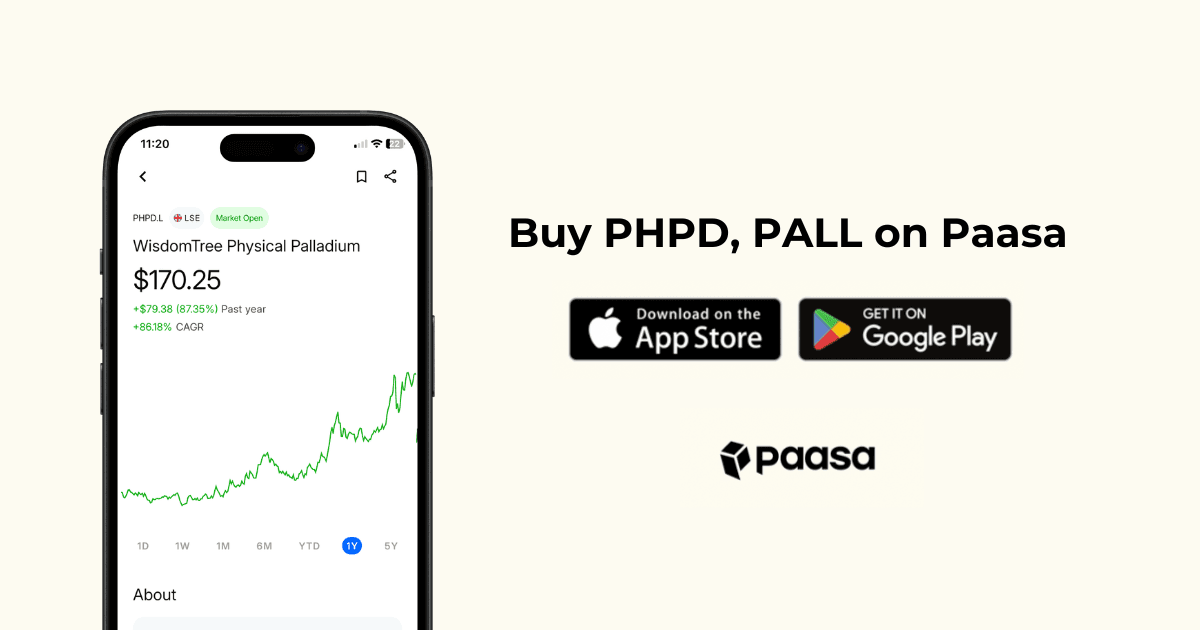
- European Fund (Tax Efficient): WisdomTree Physical Palladium
- Ticker: PHPD
- Exchange: London Stock Exchange (LSE)
- Structure: ETC (Exchange Traded Commodity)
- Why: Backed by physical metal held in London vaults.
- US Fund (Standard): Aberdeen Standard Physical Palladium Shares
- Ticker: PALL
- Exchange: NYSE Arca
- Why: The largest palladium ETF in the world.
- Note: Listed in the US.
2. Mining Stocks
- Sibanye-Stillwater (US/South Africa):
- Ticker: SBSW
- Exchange: NYSE
- Profile: One of the world's largest PGM (Platinum Group Metals) producers with major mines in the US and South Africa.

Which route is right for you?
| Physical Palladium ETCs | Mining Stocks | Domestic Futures (MCX) |
Primary Goal | Own the actual metal (Store of value). | Aggressive growth via business leverage. | Short-term hedging/trading. |
Dividend Income | None. | Yes (Variable/Cyclical). | None. |
Key Risk | Storage Fees: ~0.50% annual fee. | Operational Risk: Strikes in S. Africa. | Expiry: Contracts expire monthly. |
Leverage | None (1:1 with metal). | High: Profits explode if prices rise. | Extreme: Built-in leverage. |
Best For | Long-term investors. | Risk-tolerant investors. | Professional Traders. |
Why Indian investors should choose non-US palladium funds
For Indians investing globally, where a fund is located should be an important consideration, as US-domiciled funds and stocks come with a significant taxation risk.
The United States enforces a strict Estate Tax on non-residents. If you hold US-domiciled assets (such as the PALL ETF or stocks like Sibanye-Stillwater (SBSW) listed on the NYSE) and pass away, the US government levies a up to 40% tax on the value of those assets above $60,000.
This means that in the event of an untoward incident, your heirs could lose nearly half of your US-based portfolio to the IRS before the money is even repatriated to India.
This risk makes US funds a poor choice for long-term wealth preservation.
Even for short-term traders, holding these assets carries an unnecessary risk; if an unexpected event occurs while the position is open, the tax implications for your family are severe.
For more information on how the Estate tax can affect your investments, read How the US Estate Tax Works for Indians and NRIs.
The Solution: Non-US Funds
Funds listed on non-US exchanges (European exchanges like the London Stock Exchange, Swiss Stock Exchange, etc.) do not carry this risk.
They also provide the same exposure to commodities (or stocks). For example, you can replace the US-listed PALL with the London-listed WisdomTree Physical Palladium (PHPD) to get the exact same price exposure.
By choosing the non-US version of a fund, you get the same palladium exposure but completely eliminate the risk of a 40% tax wipeout. For Indian investors, this structural safety makes non-US funds the superior choice.
Invest in Palladium with Paasa
Paasa is a truly global platform designed for the modern Indian investor. We provide direct access to over 10 global exchanges, including the United States, United Kingdom, Switzerland, Hong Kong, Germany, France, Canada, Netherlands, Japan, and Singapore.
This means you are not restricted to just US funds. You can buy the tax-efficient WisdomTree Physical Palladium (PHPD) directly from India.
The Compliance Advantage
- Schedule FA Reporting: We generate the exact reports you need for your Indian tax returns.
- Tax Filing & Advice: Seamless support for global capital gains.
- LRS Integration: Guidance on FEMA regulations and limits.
Whether you want to hedge your portfolio with physical palladium or buy global miners, Paasa provides the access and compliance you need.
What other commodities can I invest in with Paasa?
Paasa provides access to all commodities and stocks listed on global stock exchanges across US, Europe and Asia.
Disclaimer
This article is intended for information only and does not constitute investment, tax, or legal advice. The material is based on public sources and our interpretation of current regulations, which may change. Investing in global markets entails risks, including currency risk, political risk, and market volatility. Past performance does not predict future outcomes. Please seek advice from qualified financial, tax, and legal professionals before acting.

